Capabilities

We deliver code and pipelines.
Not runbooks for human clicking.

Four disciplines. One operating model. Every engagement combines them — so there are no gaps for your team to plug, no spreadsheets pretending to be governance, and nothing your auditor can't see.

01 · Terraform & IaC

Versioned infrastructure. Reviewed like product code.

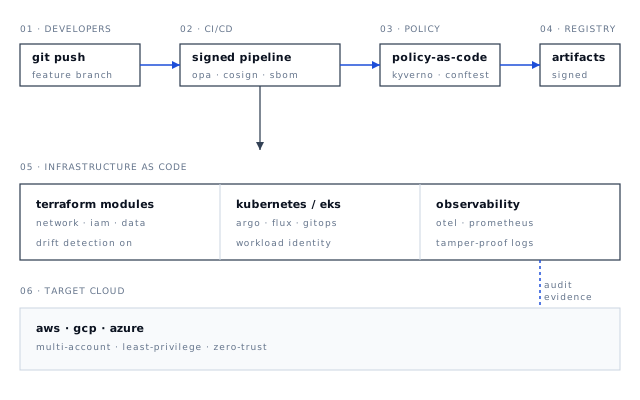
A module library tailored to your accounts, your topology, your compliance posture. Drift detection in CI. State managed and locked. Every change ships through PR review with policy gates.

  • Curated Terraform module library
  • State backend hardening + remote locking
  • Drift detection on every PR + nightly
  • Multi-account scaffolding (AWS Organizations, GCP folders)
  • OPA / Conftest policy gates pre-plan
  • Secrets via cloud KMS — never in state

Outcome → A reproducible, reviewable platform that an auditor can verify in minutes.
platform.tf versioned
Platform architecture diagram showing flow from developers through CI, policy enforcement, and IaC to cloud.

02 · Kubernetes / EKS

Production-grade clusters. GitOps-first.

Clusters designed for scale, isolation, and identity. Workloads deployed by Argo or Flux — never kubectl-by-hand. Network policy on, secrets brokered, autoscaling tuned, upgrades automated.

  • EKS / GKE / AKS cluster design
  • Argo CD or Flux GitOps pipelines
  • Workload identity (IRSA, GKE WI)
  • Network policy + service mesh as needed
  • Cluster autoscaler + Karpenter tuning
  • Patched, version-managed upgrade flow

Outcome → A cluster your team can ship to confidently, and your auditor can review without surprises.

cluster.yaml gitops
apiVersion: argoproj.io/v1
kind: Application
metadata:
  name: platform
spec:
  project: snowops
  source:
    repoURL: git@github.com/acme/infra
    path: clusters/prod
    targetRevision: main
  destination:
    server: https://kubernetes.default.svc
    namespace: platform
  syncPolicy:
    automated:
      prune: true
      selfHeal: true
    syncOptions:
      - ServerSideApply=true
      - CreateNamespace=true

03 · CI/CD Governance

Pipelines that enforce themselves.

Builds are signed. Promotions are gated. Approvals are code, not Slack messages. Every artifact carries an attestation; every environment knows what it's allowed to run.

  • GitHub Actions or GitLab CI hardening
  • OIDC-based cloud auth (no static keys)
  • Cosign signing + SBOM attestation
  • Environment promotion via PR
  • Required-reviewer policies enforced
  • Reusable, audited workflow libraries

Outcome → A change pipeline that satisfies CC1 / CC8 controls without a human auditor babysitting it.

release.yml signed
permissions:
  id-token: write
  contents: read
  attestations: write

jobs:
  build:
    runs-on: ubuntu-latest
    steps:
      - uses: actions/checkout@v4
      - uses: docker/build-push-action@v6
      - uses: sigstore/cosign-installer@v3
      - run: cosign sign --yes ${IMAGE}
      - uses: actions/attest-build-provenance@v1
        with:
          subject-name: ${IMAGE}

04 · Policy as Code

SOC 2 and ISO 27001 controls — enforced in the pipeline.

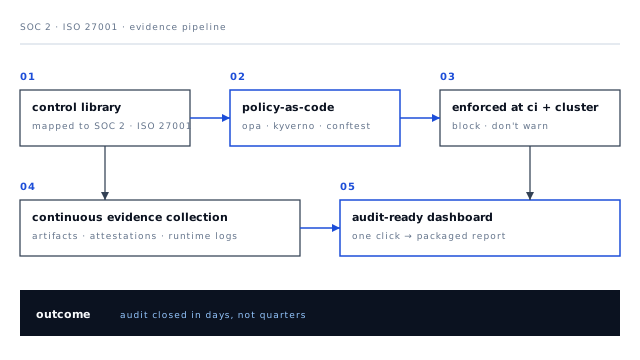
We translate your control framework into executable policy. Kyverno for the cluster, OPA / Conftest for CI, custom rules where your auditor needs them. Evidence is collected continuously and packaged on demand.

  • SOC 2 / ISO 27001 control mapping
  • Kyverno cluster policies
  • OPA / Conftest CI policies
  • Continuous evidence collection
  • Auditor-ready evidence packages
  • Policy versioning + change history

Outcome → Audits close in days. New controls ship like features.

evidence.pipeline continuous
Compliance pipeline diagram: control library mapped to policy-as-code, enforced at CI and cluster, with continuous evidence and audit-ready dashboard.

Security by default

Zero-trust isn't a slogan. It's the wiring.

The defaults of every platform we ship — every cluster, every pipeline, every IAM policy — are built on these four principles. No opt-in. No 'we'll harden it later.'

Least privilege

IAM scoped per workload. Wildcard policies fail CI.

Identity, not keys

OIDC, workload identity, short-lived credentials.

Signed everything

Cosign-signed images. SBOMs attached. Drift blocked.

Tamper-evident

Append-only audit logs. Evidence ships with the deploy.

Engagement

Start with an assessment. Decide on a sprint.

The TAR (Technical Assessment Report) is free, takes ~2 weeks, and requires no backend access. From there we propose a scoped engagement — typically 2–6 sprints.

Request your TAR